/* Aljaweea — footer "Cookie Preferences" link opens the Complianz banner.
* Original by Digency (19 Aug 2026); amended 8 Sep 2026, runbook 5.14:
* - e.preventDefault() so the href="#" no longer scrolls the page to the top;
* - calls Complianz's own cmplz_set_banner_status('show') and falls back to
* clicking the (hidden) Manage-consent button if that function is absent.
* Rollback: restore the original 12-line version recorded in the runbook. */
document.addEventListener('click', function (e) {
var link = e.target.closest('.cmplz-show-banner');
if (!link) { return; }
e.preventDefault();
if (typeof cmplz_set_banner_status === 'function') {
cmplz_set_banner_status('show');
} else {
document.querySelectorAll('.cmplz-manage-consent').forEach(function (btn) { btn.click(); });
}
});
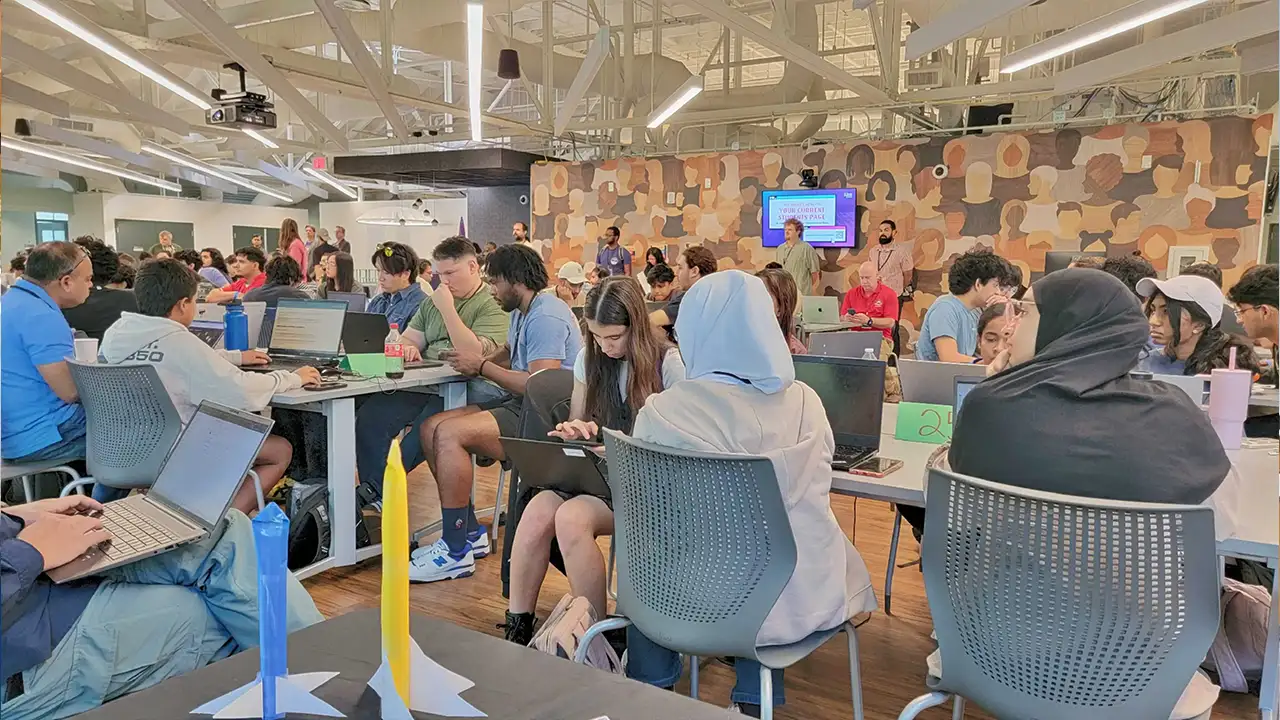
Participants work on their projects at the 2025 NASA Space Apps Challenge in Austin, Texas, one of more than 50 local events in the United States. Handout: NASA Space Apps.
Arab Teams Take Part in 2026 NASA Space Apps Challenge
Oman, Kuwait, Egypt and Algeria Announce Local Winners and Nominate Teams for Global Judging
Oman, Kuwait, Jordan, Bahrain, Egypt and Algeria have announced their local winning teams in the 2026 NASA Space Apps Challenge. Oman, Kuwait, Egypt and Algeria have put teams forward for global judging.
This year’s hackathon broke records, drawing the highest participation since the competition began in 2012, with 181,835 registrants worldwide. NASA will publish the list of global nominees on 3 December 2026. The finalists will follow on 17 December, and the global winners will be announced in January 2027.
The real shortlisting starts after that, when experts from NASA and its partner agencies review the nominees, of whom there were more than 1,290 in the 2025 edition. On 17 December, they will announce the global finalists and honourable mentions. An executive panel from NASA and the partner agencies will then choose ten global winners, to be announced on 26 January 2027.
NASA gives ten global awards. According to the official page for the Manama event on the NASA-run challenge website, the categories are Best Use of Science, Best Use of Data, Best Use of Technology, Galactic Impact, Best Mission Concept, Most Inspirational, Best Storytelling, Global Connection, Art and Technology, and Local Impact. Each local event sets its own awards alongside them: Manama set three, and Oman announced ten that mirror the global categories.
Arab Involvement at Several Levels
Arab involvement went beyond the competing teams. Two Arab space agencies are among NASA’s 17 partner space agencies, which make their data available to participants alongside NASA’s to tackle real-world challenges and problems on Earth and in space.
Other Arab countries hosted local events, and teams from Saudi Arabia and Qatar took part in Oman’s hackathon. Experts from NASA and the partner agencies help assess the global nominees and choose the finalists.
Six Arab countries have announced the results of their local events. The published detail varies, from full team and project names to general announcements with no names. NASA will publish the official list of global nominees in December.
Kuwait
The American University of Kuwait, as local lead, hosted the hackathon for the seventh consecutive year, under the theme “The Next Frontier”. Al-Anba reported 418 participants. Dr Marwa Sharawi, associate professor at the university’s College of Engineering and Applied Sciences and local lead organiser of the Space Apps Challenge 2026, said the hackathon brought together 400 participants in 80 teams, and that numbers were up about 88% on the previous edition. The winning teams have been announced, according to the local committee, and six Kuwaiti teams were nominated for global judging.
The first-place team at the 2026 NASA Space Apps Challenge in Kuwait receives a 1,000 KD prize. Handout: American University of Kuwait.Oman
On Sunday, 15 November, ten teams were announced as local winners in the wilayat of Bidiyah, at an event organised by the University of Technology and Applied Sciences in Ibra, with 939 contestants in 166 teams taking part. The winners were Smart Observers (data use), Sound Sphere (art), NovaCare (technology), Space Horizons (use of technology), Extra X Link (storytelling), Sky X (science), Sultan Qaboos Air Academy (global connection), Suhd (global and local impact), Code Blue (mission concept) and Neon Genesis (most inspiring team). Five of these teams were nominated to represent Oman in the global competition, according to the local committee’s announcement, and the official list is expected in December.
Jordan
In Irbid, team Bracken (student Karam Hisham Hteini of Zarqa University) won first place among 64 teams with its project CAIRN. The project is an intelligent system that plans safe routes for astronauts on the surface of Mars, focusing on Jezero and Gale craters and taking into account oxygen reserves, radiation levels and communication range.
Ain Shams University said Hawkins Crew, a team from its Faculty of Science, came third at the Giza event and was among the nominees for global judging. The team is made up of fourth-year students in the mathematics department (computer science): Zeinab Amr Mahmoud, Fatma Saeed Ali, Omar Nagy, Marwan Wael and Omar Al-Omari.
The team presented SciVerse, an interactive platform built in 48 hours that compares sites on Earth by terrain, geological formations and temperature to gauge how closely they resemble the environments of the Moon and Mars. The faculty’s dean, Dr Tamer Sharaf, said the project aims to produce an interactive map and a database to help researchers.
Participants at the NASA Space Apps Challenge local event in Boumerdès, Algeria, where team VETO4 of the École Supérieure en Informatique de Sidi Bel Abbès took first place. Handout: École Supérieure en Informatique de Sidi Bel Abbès.Algeria
The project is an interactive farming platform, built for the Field Shift challenge, that simulates farm scenarios and compares crop-rotation strategies using NASA data, with a smart assistant. Algerian newspaper Ennahar described it as a candidate for the global competition; NASA will publish the official list in December.
Stay informed. Get the latest aviation and space news from the Arab world on WhatsApp and Telegram as soon as it is published, or subscribe to our newsletter for a weekly round-up. You can also add us to your preferred sources to see more of our stories in Google Search.
We use cookies to run this site, to measure readership and to show the advertising that funds our journalism. In your region, non-essential cookies stay off until you accept them. Accept all, deny all, or choose by category. You can change your choice at any time via the Cookie Preferences link at the bottom of every page.
Functional Always active
Needed for the site to work: your language, your cookie choice, form security and the WordPress session. Always active.
Preferences
Remember settings you have chosen so that you do not have to set them again on your next visit.
Statistics
Google Analytics, to see which articles are read, from where and on which devices. IP addresses are shortened before storage.The technical storage or access that is used exclusively for anonymous statistical purposes. Without a subpoena, voluntary compliance on the part of your Internet Service Provider, or additional records from a third party, information stored or retrieved for this purpose alone cannot usually be used to identify you.
Marketing
Advertising served by Google AdSense, embedded videos and social-media buttons, and measurement pixels for our own posts on social platforms.
We use cookies to run this site, to measure readership and to show the advertising that funds our journalism. They are active unless you deny them here. You can change your choice at any time via the Cookie Preferences link at the bottom of every page.
Functional Always active
Needed for the site to work: your language, your cookie choice, form security and the WordPress session. Always active.
Preferences
Remember settings you have chosen so that you do not have to set them again on your next visit.
Statistics
Google Analytics, to see which articles are read, from where and on which devices. IP addresses are shortened before storage.The technical storage or access that is used exclusively for anonymous statistical purposes. Without a subpoena, voluntary compliance on the part of your Internet Service Provider, or additional records from a third party, information stored or retrieved for this purpose alone cannot usually be used to identify you.
Marketing
Advertising served by Google AdSense, embedded videos and social-media buttons, and measurement pixels for our own posts on social platforms.
var molongui_authorship_byline_params = {"byline_modifiers_enabled":"","byline_prefix":"","byline_suffix":"","byline_separator":",\u00a0","byline_last_separator":"\u00a0and\u00a0","byline_link_title":"View all posts by","byline_link_class":"","byline_dom_tree":"","byline_dom_prepend":"","byline_dom_append":"","byline_decoder":"v3","byline_data_url":"https://aljaweea.com/wp-json/molongui-authorship/v1/bylines","byline_rest_nonce":""};
//# sourceURL=molongui-authorship-byline-js-extra
var tie = {"is_rtl":"","ajaxurl":"https://aljaweea.com/wp-admin/admin-ajax.php?lang=en","is_side_aside_light":"","is_taqyeem_active":"","is_sticky_video":"1","mobile_menu_top":"","mobile_menu_active":"area_1","mobile_menu_parent":"","lightbox_all":"true","lightbox_gallery":"true","lightbox_skin":"dark","lightbox_thumb":"horizontal","lightbox_arrows":"true","is_singular":"1","autoload_posts":"","reading_indicator":"true","lazyload":"","select_share":"","select_share_twitter":"true","select_share_facebook":"true","select_share_linkedin":"true","select_share_email":"true","facebook_app_id":"5303202981","twitter_username":"","responsive_tables":"true","ad_blocker_detector":"","sticky_behavior":"default","sticky_desktop":"true","sticky_mobile":"true","sticky_mobile_behavior":"default","ajax_loader":"\u003Cdiv class=\"loader-overlay\"\u003E\u003Cdiv class=\"spinner-circle\"\u003E\u003C/div\u003E\u003C/div\u003E","type_to_search":"1","lang_no_results":"Nothing Found","sticky_share_mobile":"","sticky_share_post":"","sticky_share_post_menu":""};
//# sourceURL=tie-scripts-js-extra
let cmplzBlockedContent = document.querySelector('.cmplz-blocked-content-notice');
if ( cmplzBlockedContent) {
cmplzBlockedContent.addEventListener('click', function(event) {
event.stopPropagation();
});
}
//# sourceURL=cmplz-cookiebanner-js-after
/* Accessibility quick fixes (WCAG 2.2 AA test, 27 Oct 2026). Safe to switch off.
1 skip link · 2 form autofill · 3 language switcher name · 4 dark-mode button name and state
5 mobile menu state and focus · 6 heading levels for screen readers · 7 author photos
8 form errors linked to fields · 9 "opens in a new tab" for screen readers · 10 main content area · 11 Arabic hidden form titles */
(function () {
var isAr = (document.documentElement.lang || '').toLowerCase().indexOf('ar') === 0;
var T = isAr
? { skip: 'تخطَّ إلى المحتوى الرئيسي', dark: 'الوضع المظلم', newTab: ' (يُفتح في علامة تبويب جديدة)' }
: { skip: 'Skip to main content', dark: 'Dark mode', newTab: ' (opens in a new tab)' };function visible(el) {
if (!el) { return false; }
var r = el.getBoundingClientRect(), s = getComputedStyle(el);
return r.width > 0 && r.height > 0 && s.visibility !== 'hidden' && s.display !== 'none' && r.right > 0 && r.left < window.innerWidth;
}function run() {
/* 1. Skip link (WCAG 2.4.1): jumps to the first block after the site header */
var header = document.getElementById('theme-header');
var target = header ? header.nextElementSibling : null;
while (target && (target.tagName === 'SCRIPT' || target.tagName === 'STYLE')) { target = target.nextElementSibling; }
if (target && !document.querySelector('.aj-skip-link')) {
if (!target.id) { target.id = 'aj-main'; }
if (!target.hasAttribute('tabindex')) { target.setAttribute('tabindex', '-1'); }
var a = document.createElement('a');
a.className = 'aj-skip-link';
a.href = '#' + target.id;
a.textContent = T.skip;
a.addEventListener('click', function () { setTimeout(function () { target.focus({ preventScroll: true }); }, 0); });
document.body.insertBefore(a, document.body.firstChild);
}/* 10. Main content area (WCAG 1.3.1): pages with none (the home pages) get one */
if (target && !document.querySelector('main, [role="main"]') && !target.querySelector('footer, #footer')) {
target.setAttribute('role', 'main');
}/* 2. Form autofill (WCAG 1.3.5) */
var inputs = document.querySelectorAll('form input');
for (var i = 0; i < inputs.length; i++) {
var el = inputs[i];
if (el.getAttribute('autocomplete')) { continue; }
var n = (el.name || '').toLowerCase();
var l = ((el.labels && el.labels[0] && el.labels[0].textContent) || el.getAttribute('aria-label') || el.placeholder || '').toLowerCase().trim();
var v = null;
if (el.type === 'email') { v = 'email'; }
else if (el.type === 'tel' || (/phone|هاتف|جوال/.test(l) && !/mail|بريد/.test(l))) { v = 'tel'; }
else if (/first_name/.test(n)) { v = 'given-name'; }
else if (/last_name/.test(n)) { v = 'family-name'; }
else if (el.type === 'text' && /^(name|full name|الاسم|الإسم)\b/.test(l)) { v = 'name'; }
else if (el.type === 'url') { v = 'url'; }
if (v) { el.setAttribute('autocomplete', v); }
}/* 3. Language switcher (WCAG 2.4.4, 3.1.2): name the target language in that language */
var sw = document.querySelectorAll('a.lang-toggle');
for (var s = 0; s < sw.length; s++) {
var toAr = /\/ar(\/|$)/.test(sw[s].getAttribute('href') || '');
var name = toAr ? 'العربية' : 'English';
sw[s].setAttribute('aria-label', name);
sw[s].setAttribute('title', name);
sw[s].setAttribute('lang', toAr ? 'ar' : 'en');
sw[s].setAttribute('hreflang', toAr ? 'ar' : 'en');
var ims = sw[s].querySelectorAll('img');
for (var k = 0; k < ims.length; k++) { ims[k].setAttribute('alt', ''); }
}/* 4. Dark-mode button (WCAG 4.1.2): clear name, behaves as a toggle button that reports on/off */
var skins = document.querySelectorAll('a.change-skin');
function isDark() { return document.documentElement.classList.contains('dark-skin'); }
function syncSkin() { for (var q = 0; q < skins.length; q++) { skins[q].setAttribute('aria-pressed', isDark() ? 'true' : 'false'); } }
for (var d = 0; d < skins.length; d++) {
skins[d].setAttribute('role', 'button');
skins[d].setAttribute('aria-label', T.dark);
skins[d].setAttribute('title', T.dark);
skins[d].addEventListener('click', function () { setTimeout(syncSkin, 300); });
skins[d].addEventListener('keydown', function (e) { if (e.key === ' ') { e.preventDefault(); this.click(); } });
}
syncSkin();/* 5. Mobile menu (WCAG 4.1.2, 2.4.3): report open/closed, move focus in on open and back on close */
var btn = document.getElementById('mobile-menu-icon');
var panel = document.querySelector('.side-aside');
if (btn && panel) {
btn.setAttribute('role', 'button');
btn.setAttribute('aria-expanded', 'false');
if (!panel.id) { panel.id = 'aj-mobile-menu'; }
btn.setAttribute('aria-controls', panel.id);
var check = function (moveFocus) {
setTimeout(function () {
var open = visible(panel);
btn.setAttribute('aria-expanded', open ? 'true' : 'false');
if (open && moveFocus) {
var first = panel.querySelector('a[href]:not(.close-side-aside), button');
if (first) { first.focus(); }
}
if (!open && moveFocus === 'back') { btn.focus(); }
}, 450);
};
btn.addEventListener('click', function () { check(true); });
var closers = panel.querySelectorAll('.close-side-aside');
for (var c = 0; c < closers.length; c++) { closers[c].addEventListener('click', function () { check('back'); }); }
document.addEventListener('keydown', function (e) {
if (e.key === 'Escape' && btn.getAttribute('aria-expanded') === 'true') {
setTimeout(function () {
/* the theme closes the menu on Escape in English but not in Arabic */
var x = panel.querySelector('.close-side-aside');
if (visible(panel) && x) { x.click(); }
check('back');
}, 150);
}
});
}/* 6. Heading levels (WCAG 1.3.1): no jumps for screen readers; looks unchanged */
var hs = document.querySelectorAll('h1, h2, h3, h4, h5, h6');
var prev = 0, hasH1 = !!document.querySelector('h1');
for (var h = 0; h < hs.length; h++) {
if (!visible(hs[h]) && !hs[h].closest('.side-aside')) { continue; }
var lvl = parseInt(hs[h].tagName.charAt(1), 10);
var eff = lvl;
if (!hasH1 && prev === 0) { eff = 1; }
else if (prev && lvl > prev + 1) { eff = prev + 1; }
if (eff !== lvl) { hs[h].setAttribute('aria-level', String(eff)); }
prev = eff;
}/* 7. Author photos: describe a linked photo by the author's name (it is the link's name); otherwise decorative */
var boxes = document.querySelectorAll('.about-author, .author-box, .m-a-box, .molongui-author-box');
for (var b = 0; b < boxes.length; b++) {
var pics = boxes[b].querySelectorAll('img');
for (var p = 0; p < pics.length; p++) {
var lk = pics[p].closest('a[href]');
var who = '';
if (lk) {
var byline = document.querySelector('a.author-name[href="' + lk.getAttribute('href') + '"]');
var strong = boxes[b].querySelector('.m-a-box-bio strong, [itemprop="name"]');
who = ((byline && byline.textContent) || (strong && strong.textContent) || '').trim();
}
if (lk && !who) { continue; } /* name not found: keep the existing description so the link keeps a name */
pics[p].setAttribute('alt', who);
}
}/* 9. "Opens in a new tab" for screen-reader users (W3C technique G201) */
var blanks = document.querySelectorAll('a[target="_blank"]');
for (var t = 0; t < blanks.length; t++) {
if (blanks[t].querySelector('.aj-newtab')) { continue; }
var sr = document.createElement('span');
sr.className = 'screen-reader-text aj-newtab';
sr.textContent = T.newTab;
blanks[t].appendChild(sr);
if (blanks[t].hasAttribute('aria-label')) { blanks[t].setAttribute('aria-label', blanks[t].getAttribute('aria-label') + T.newTab); }
}
}/* 8. Form errors (WCAG 3.3.1): link each error message to its field when it appears */
function linkErrors(root) {
var errs = (root || document).querySelectorAll('.ff-el-group .error, .ff-el-group .text-danger');
for (var e = 0; e < errs.length; e++) {
var grp = errs[e].closest('.ff-el-group');
var field = grp ? grp.querySelector('input:not([type=hidden]), select, textarea') : null;
if (!field) { continue; }
if (!errs[e].id) { errs[e].id = 'aj-err-' + Math.random().toString(36).slice(2, 9); }
var ids = (field.getAttribute('aria-describedby') || '').split(' ').filter(Boolean);
if (ids.indexOf(errs[e].id) === -1) { ids.push(errs[e].id); field.setAttribute('aria-describedby', ids.join(' ')); }
}
}
function watchForms() {
var forms = document.querySelectorAll('form.frm-fluent-form');
if (!window.MutationObserver) { return; }
for (var f = 0; f < forms.length; f++) {
new MutationObserver(function () { linkErrors(); }).observe(forms[f], { childList: true, subtree: true });
}
}/* 11. Hidden form titles in Arabic (review finding 22, runbook 8.125, 14 Nov 2026).
One form serves both languages and WPML does not offer its hidden title for translation. */
function formTitles() {
if (!isAr) { return; }
var titles = { 7: 'التصحيحات والشكاوى', 8: 'أعلن معنا', 5: 'أرسل اقتراحاً', 11: 'الشراكات', 6: 'العمل معنا', 10: 'النشرة البريدية' };
var forms = document.querySelectorAll('form.frm-fluent-form');
for (var i = 0; i < forms.length; i++) {
var legend = forms[i].querySelector('legend.ff_screen_reader_title');
var title = titles[forms[i].getAttribute('data-form_id')];
if (legend && title) { legend.textContent = title; }
}
}/* 12. Tie each choice question to its options (review finding 22, runbook 8.131, 14 Nov 2026).
A screen reader then announces the question together with each choice. No visible change. */
function groupQuestions() {
var groups = document.querySelectorAll('form.frm-fluent-form .ff-el-group');
for (var i = 0; i < groups.length; i++) {
var g = groups[i];
var checks = g.querySelectorAll('input[type="radio"], input[type="checkbox"]');
var label = g.querySelector('.ff-el-input--label label');
if (checks.length < 2 || !label || g.getAttribute('role')) { continue; }
if (!label.id) { label.id = 'aj-q-' + i; }
g.setAttribute('role', checks[0].type === 'radio' ? 'radiogroup' : 'group');
g.setAttribute('aria-labelledby', label.id);
}
}function start() { run(); watchForms(); formTitles(); groupQuestions(); }
if (document.readyState === 'loading') { document.addEventListener('DOMContentLoaded', start); } else { start(); }
})();
/* Aljaweea newsletter form (form 10): on Arabic pages, pre-select the Arabic edition.
2 Nov 2026 (Claude, runbook 8.82). Decision D-05 asks for the page language to be pre-selected through
the WPML translation of the field's default value; WPML does not offer that value for translation,
so this is the flagged fallback. The stored values stay "English" / "العربية" for the FluentCRM tag routing.
Rollback: set this snippet to Draft (the Arabic page then pre-selects English). */
(function () {
function run() {
if (!/^ar/i.test(document.documentElement.lang || '')) { return; }
var radios = document.querySelectorAll('form.fluent_form_10 input[type="radio"][name="dropdown"]');
for (var i = 0; i < radios.length; i++) {
if (radios[i].value === 'العربية') { radios[i].checked = true; radios[i].dispatchEvent(new Event('change', { bubbles: true })); }
}
}
/* Runs whether or not the page has finished loading (Breeze may delay scripts). */
if (document.readyState === 'loading') { document.addEventListener('DOMContentLoaded', run); } else { run(); }
})();
/* Aljaweea forms: let Fluent Forms show its own error messages.
2 Nov 2026 (Claude, runbook 8.86; finding V-1 of the 8.85 test). Without this, the browser's own email check
stops the form when an address has no "@" and shows the browser's pop-up in the browser's language (English on
Arabic pages for most visitors), so our message from the forms standard (1.4) never appears.
"novalidate" switches off only the browser's own check: Fluent Forms still checks every field in the browser
and again on the server, so a badly formed address is still refused - now with our wording, in the page language.
Rollback: set this snippet to Draft. */
(function () {
function run() {
var forms = document.querySelectorAll('form.frm-fluent-form');
for (var i = 0; i < forms.length; i++) { forms[i].setAttribute('novalidate', 'novalidate'); }
}
/* Runs whether or not the page has finished loading (Breeze may delay scripts). */
if (document.readyState === 'loading') { document.addEventListener('DOMContentLoaded', run); } else { run(); }
})();
ai_front = {"insertion_before":"BEFORE","insertion_after":"AFTER","insertion_prepend":"PREPEND CONTENT","insertion_append":"APPEND CONTENT","insertion_replace_content":"REPLACE CONTENT","insertion_replace_element":"REPLACE ELEMENT","visible":"VISIBLE","hidden":"HIDDEN","fallback":"FALLBACK","automatically_placed":"Automatically placed by AdSense Auto ads code","cancel":"Cancel","use":"Use","add":"Add","parent":"Parent","cancel_element_selection":"Cancel element selection","select_parent_element":"Select parent element","css_selector":"CSS selector","use_current_selector":"Use current selector","element":"ELEMENT","path":"PATH","selector":"SELECTOR"};